Consumer app
React NativeExpoTypeScript
Mritunjay Saha
I build and ship production mobile and web products with React Native, React and TypeScript.
Flagship Product
Medicines in Minutes
Built and shipped the consumer mobile application for instant medicine delivery across Android and iOS — from MVP through production releases.
React Native · Expo · React.js · TypeScript · Redux Toolkit · WebSockets · Firebase Analytics · Firebase Crashlytics · Metadex
Platform: Android · iOS
Build & Distribution: EAS Build · EAS Updates · Google Play · App Store
Capabilities: REST APIs · Push Notifications · Deep Linking
Case Study
Software Developer (React Native), May 2025 – August 2026. Consumer app from MVP to production, plus the React Store Dashboard.
Overview & Architecture
Plazza is an instant medicine delivery platform operating across Android, iOS, and store operations. The consumer app is built with React Native, Expo, and Redux Toolkit, backed by EAS updates for rapid production releases. Store operations run on a dedicated React.js dashboard synchronized over WebSockets.
Consumer app on React Native and Expo. Store operations run on a separate React.js dashboard with WebSockets. Commerce features integrate over REST APIs.
Product Experience
A complete mobile commerce flow — from discovering medicines to placing an order and following it through delivery.
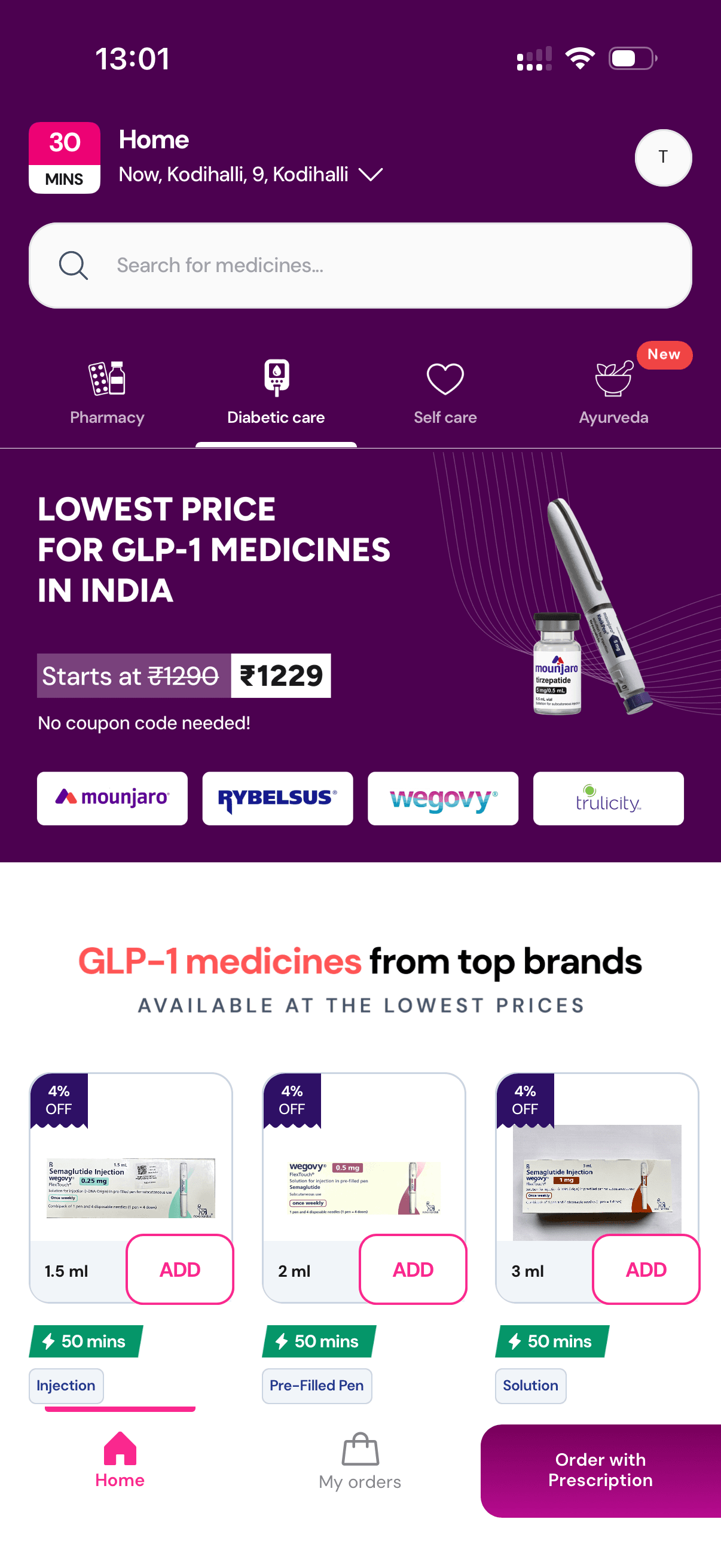
Browse medicines, categories, and availability with delivery expectations visible from the start.
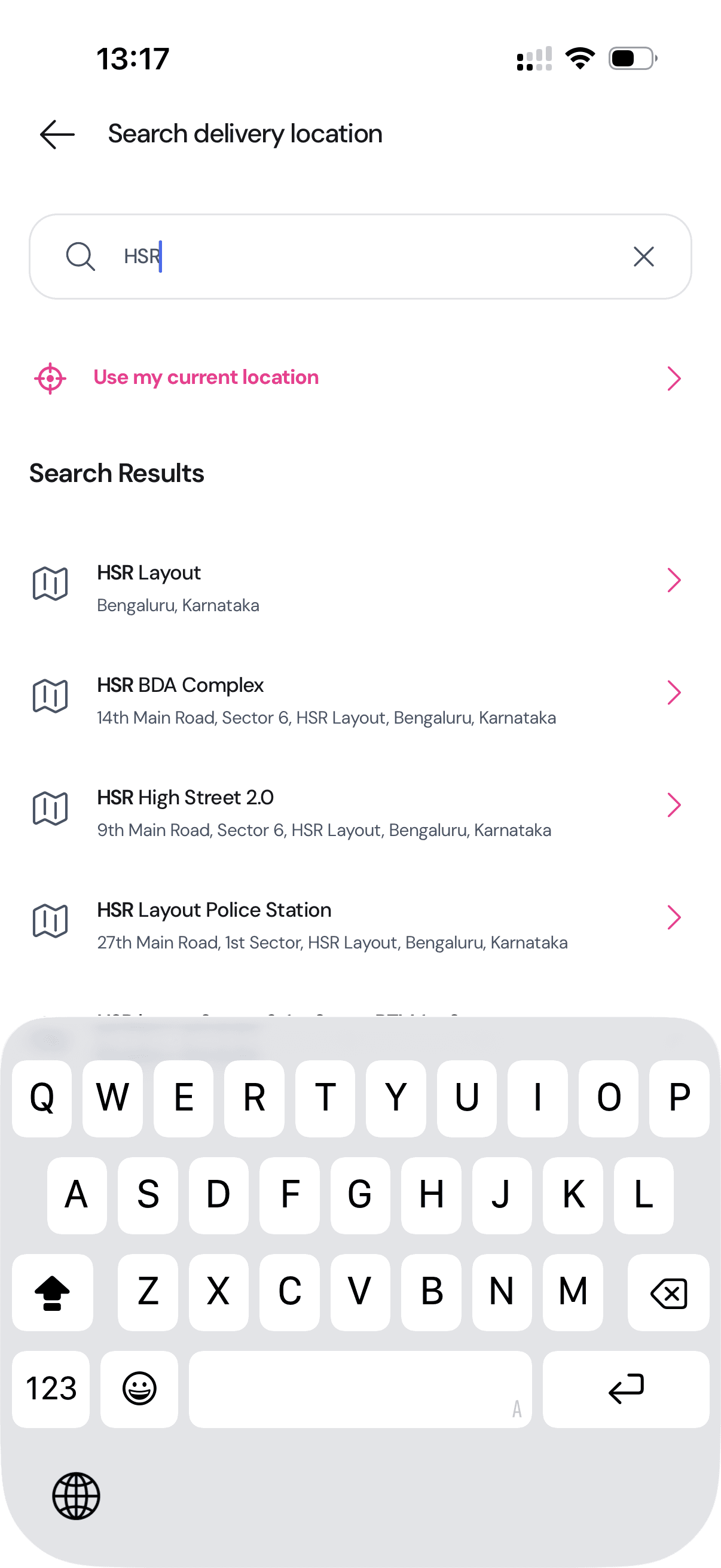
Find medicines quickly through search and location-aware discovery.
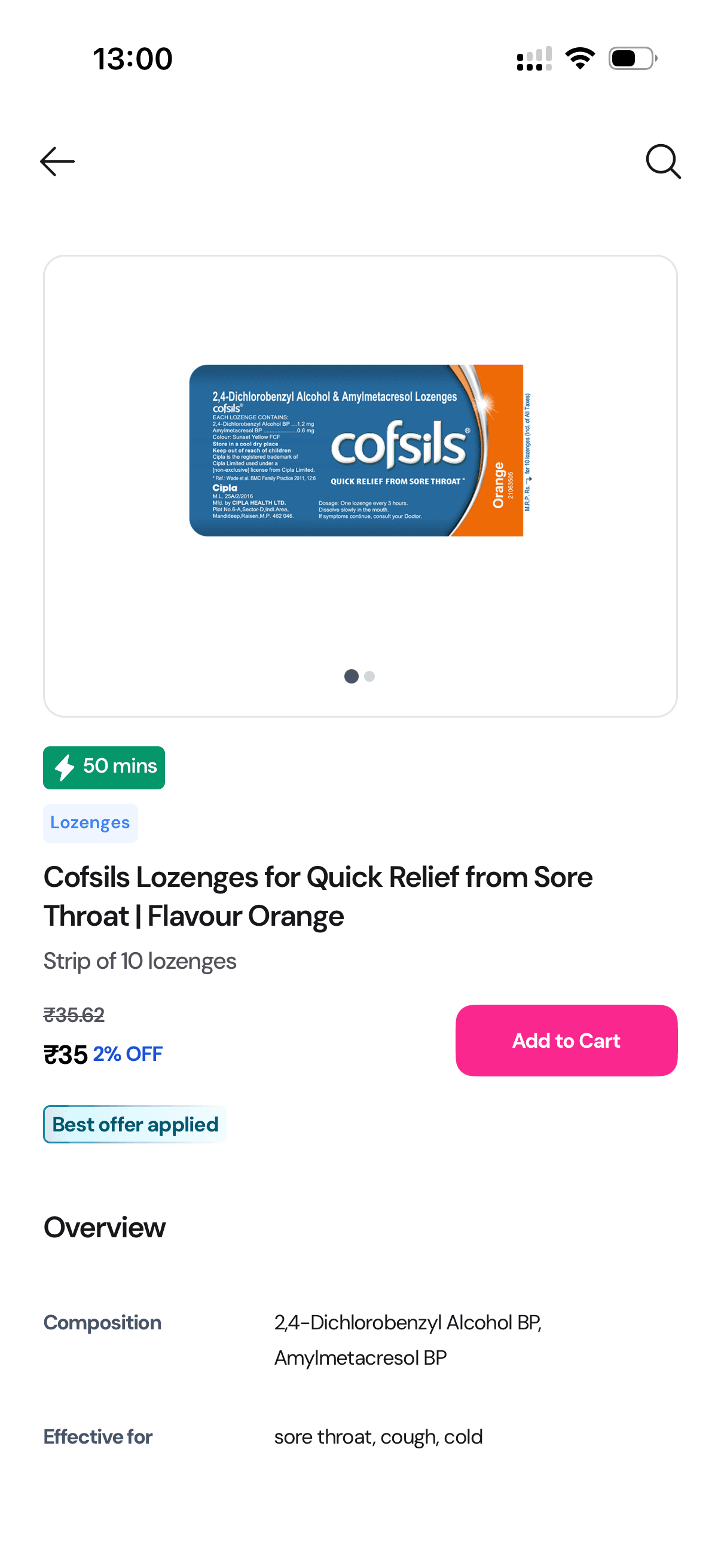
Inspect medicine details, pricing, and availability before adding to the cart.
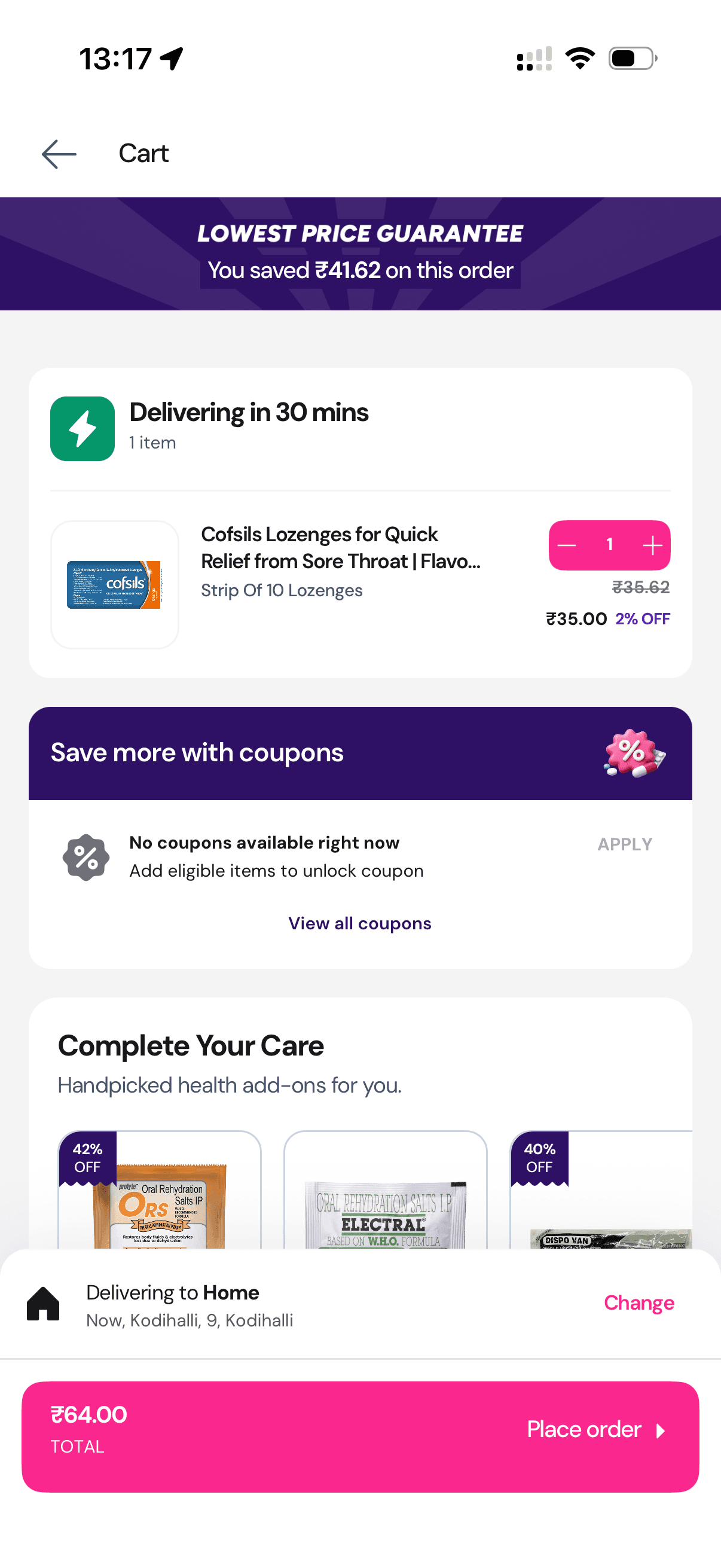
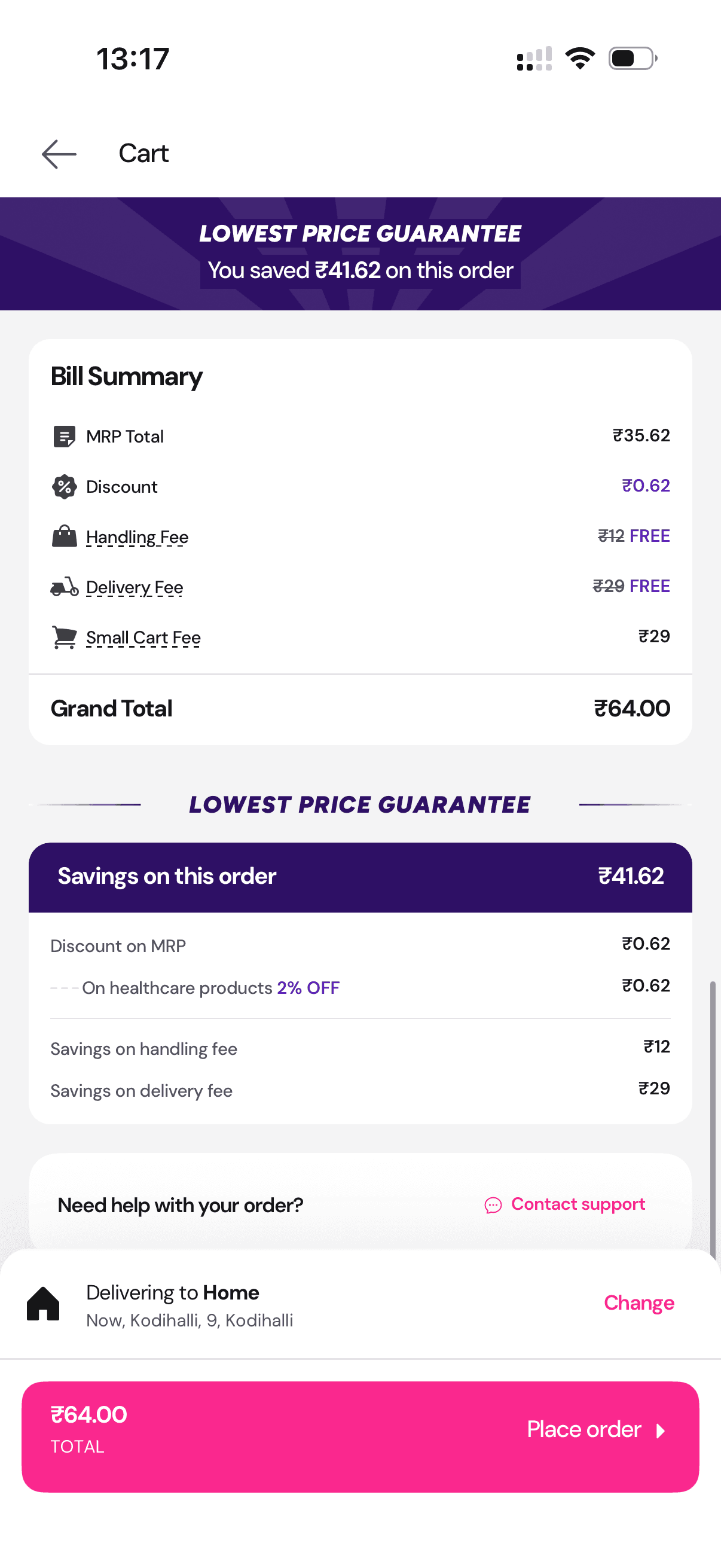
Review items, savings, and the order before moving into checkout.
A focused checkout flow for confirming address, payment, and the final order total.
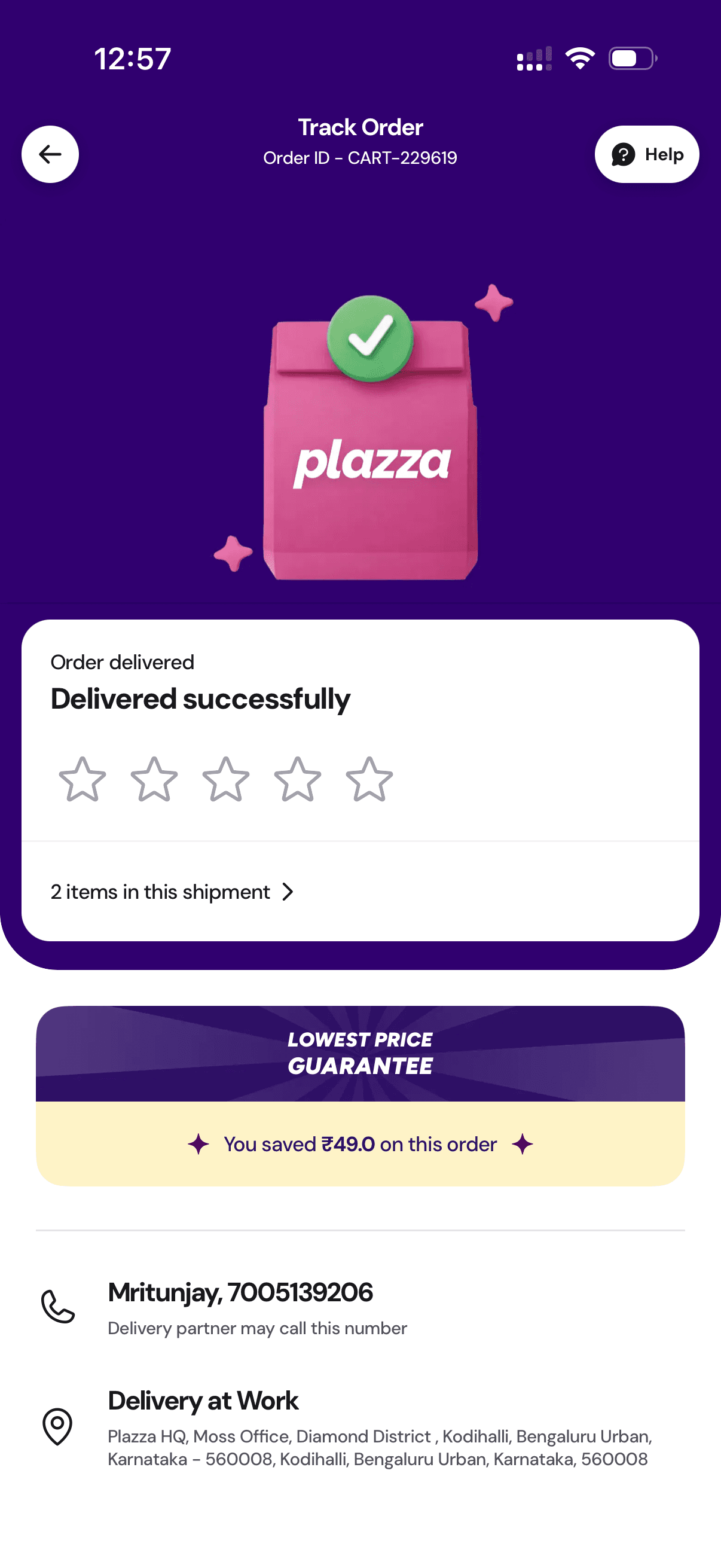
Once placed, the commerce journey continues into real-time order tracking.
React.js · TypeScript · Tailwind CSS · WebSockets
Sanitized production simulation with synthetic data (Internal store operations tooling built with React.js, TypeScript, and WebSockets). Built an internal dashboard with React.js, TypeScript, Tailwind CSS, and WebSockets for order dispatch workflows. Store teams could see and act on orders in closer to real time.
Engineering Deep Dive
Designing an isolated, offline-buffered analytics SDK for React Native to eliminate UI jank and provide 100% conversion funnel telemetry.
At Plazza (30K+ monthly installs, 2,200+ DAU, ₹3L+ daily GMV), conversion data was split between the React Native consumer app and a React web store operations dashboard. As feature velocity accelerated, ad-hoc logging calls scattered across components caused severe schema drift, missing drop-off events, and inconsistent naming between platforms.
During rapid cart manipulations—such as quantity toggles and real-time AI prescription item extraction—synchronous event logging calls competed for the JavaScript bridge. On budget Android devices, this caused noticeable UI micro-stutters during time-critical checkout actions. Furthermore, customers on unstable cellular networks lost entire event batches when the app was closed before Firebase flushed.
The initial version wrote full event payloads to storage synchronously on every dispatch, which caused brief storage I/O contention during prolonged offline sessions. I resolved this by introducing an in-memory batch coalescing layer and capping local offline queue depth to 500 records.
Production & Release Cadence
Managed store releases across Google Play and Apple App Store. Monitored Firebase Crashlytics to maintain a 99.5%+ crash-free user rate on Android and 99.9%+ on iOS. Utilized EAS Update for instant OTA JavaScript patch deployment without waiting for full review cycles.
The consumer app is live and active on both primary mobile app marketplaces.
React Case Study
A React and TypeScript Chrome extension for autofill, login, and credential updates.
React · TypeScript · Webpack
At Ziroh Labs, I engineered an enterprise Password Manager Chrome Extension in React.js, TypeScript, and Manifest V3. The system solved two critical enterprise security constraints: zero-exposure credential injection on hostile web surfaces, and stateful session preservation across ephemeral browser service worker lifecycles.
Sanitized production simulation with synthetic data (Enterprise Chrome extension built with React.js, TypeScript, and Chrome Extension APIs).
Enterprise users required seamless browser autofill and auto-login without exposing secrets to hostile DOM environments. The core technical hurdle was twofold: protecting decrypted credentials from malicious host page scripts actively inspecting input DOM nodes, and maintaining authenticated session states when Chrome's MV3 runtime aggressively terminates inactive background service workers every 30 seconds.
Led frontend architecture and Chrome Extension engineering: designed the React/TypeScript popup and inline fill triggers, implemented the isolated-world content script injection bridge, and engineered the background worker session re-hydration mechanism.
Detected login and registration fields via MutationObservers, injecting isolated Shadow DOM triggers. Decrypted credentials were only delivered on explicit user intent, bypassing page-level keyloggers.
Injected values directly via untampered HTMLInputElement.prototype property setters within isolated execution contexts, bypassing malicious host script overrides and prototype pollution.
Handled background worker sleep cycles gracefully by storing ephemeral, non-extractable session handles in chrome.storage.session and re-authenticating seamlessly on worker wakeup.
Intercepted legitimate form submissions to prompt for vault updates and rotated credentials without leaking unencrypted form data into host page execution scopes.
Multi-factor authentication and vault unlocking through a decoupled React popup communicating via encrypted runtime message ports.
Zero plaintext credential exposure. Decrypted credentials were never held in persistent browser storage or accessible to the host page's global window object. Credential fills required explicit user gesture verification, and all inter-context communications enforced strict origin checks, CSP headers, and sanitized message boundaries.
Shipped an enterprise-grade Chrome extension deployed to corporate users across Ziroh Labs' security suite, delivering sub-50ms autofill latency with zero session drops during MV3 background worker eviction cycles and zero credential leakage to host page scripts.
Production Mobile Apps
Zunu Message and Zunu Notes are production React Native applications engineered at Ziroh Labs.
Third-party JavaScript cryptography libraries blocked the single-threaded JS runtime for 200ms+ during payload encryption on budget mobile hardware.
Led React Native frontend development and built native C++ cryptographic bridge modules.
Engineered custom Native C++ modules and JNI bridges for zero-knowledge encryption off the main thread, maintaining fluid 60fps UI gestures.
Reduced payload encryption latency by 75% and eliminated main-thread frame freezing during secure messaging.
Rendering deeply nested board hierarchies and interactive markdown notes caused severe frame drops (down to 25fps) and memory bloat on low-memory Android devices during rapid board switching and drag-and-drop card reorganization.
Architected the React Native mobile application with NativeWind, engineering the virtualized multi-column board layout, background markdown tokenization, and optimistic offline SQLite synchronization.
Engineered custom virtualized list windowing for dual-axis board scrolling, offloaded heavy markdown parsing to native background threads, and implemented optimistic local state updates with conflict-free SQLite persistence.
Achieved solid 60fps board panning and sub-100ms note retrieval across low-end and flagship devices, reducing memory consumption by 40% during extended editing sessions.
Experience
Two production roles: Plazza and Ziroh Labs.
B.Tech, Computer Science & Engineering
North Eastern Regional Institute of Science & Technology (NERIST), Arunachal Pradesh
2018 – 2022 · CGPA: 9.32/10
Services
An engineer available to build, extend, and stabilize React Native and React products — not an agency.
Production Android and iOS apps with React Native, Expo, and TypeScript — including Play Store and App Store release workflows.
Turn a product idea into a working mobile or web MVP, including prescription/AI-assisted flows where the product needs them.
Add features, fix bugs, and modernize apps already in production, including Firebase analytics, crash reporting, and store updates.
Debug crashes, improve performance, and strengthen production reliability with Crashlytics monitoring and release cadence.
Practical React and React Native decisions on state, analytics, EAS builds, and release structure.
Technology
Technologies from the resumes, grouped by how they show up in the work.
About
I am a software engineer specializing in React Native, React, and TypeScript. I have spent 4+ years building and shipping consumer applications across mobile and web in startup product teams.
At Plazza I owned the consumer React Native app from MVP to production — commerce flows, store releases, crash monitoring, and analytics — for 30K+ monthly installs and 2,200+ daily active users. I also built the internal React Store Dashboard used for order dispatch.
At Ziroh Labs I shipped React Native products (Zunu Message, Zunu Notes), native modules for cryptography and push notifications, and a React/TypeScript Password Manager Chrome Extension.
I am comfortable owning features end-to-end, working across frontend and backend boundaries, and collaborating directly with founders and product teams. Available to work with startups on React Native, React, and TypeScript products.
Contact
Tell me about the product, the stack, and the timeline. I typically respond within 24 hours.
Reach out directly without forms. I review inquiries personally and respond within 24 hours.